
The top managed service providers for 2026 combine 24/7 monitoring and help desk support, layered cybersecurity (SOC/SIEM/MDR), compliance expertise (HIPAA, CMMC, NIST, GDPR), transparent flat-rate pricing, and documented response-time SLAs. Whether you need a global enterprise MSP or a regional partner, verify these five criteria before signing a contract.
The managed services market crossed $401 billion in 2025 and keeps climbing as more businesses hand off cloud, cybersecurity, and infrastructure management to outside experts. That growth has also flooded the market with "Top 10" and "Top 100" MSP lists built on unverifiable rankings, paid placements, or revenue alone rather than actual service quality. If you're a business owner trying to find a genuinely reliable partner rather than a name on a sponsored list, the criteria matter more than the ranking.
This guide breaks down what actually separates the top managed service providers from the rest, how to evaluate best managed IT services against your specific needs, and why "largest" doesn't always mean "best fit" for a growing business.
A managed service provider (MSP) takes ongoing responsibility for a business's IT environment infrastructure, security, help desk, and strategy typically for a flat monthly fee. The top MSP providers share five characteristics regardless of size:
Providers such as Ferrara IT combine these standards into comprehensive managed cybersecurity services, pairing help desk support with SOC-level threat monitoring so businesses aren't stitching together separate vendors for support and security.
Search results for "largest MSPs" or "largest IT managed services providers" typically surface global enterprise firms Accenture, IBM, Capgemini, CDW, and similar names generating tens of billions in annual revenue. These are legitimate, capable organizations, but revenue and headcount answer a different question than the one most small and mid-sized businesses are actually asking.
If you're a 50-person law firm or a 200-employee manufacturer, the "largest" MSP on a global ranking may be the wrong fit - you'll likely be a small account inside a massive book of business. A best MSP matching service online search often surfaces this exact mismatch, which is why matching by criteria (not just size) produces better outcomes than chasing a "biggest" list.
Whether you're comparing managed network services companies or full-scope MSPs, run every candidate through this checklist.
Ask exactly what "24/7" means some providers only staff after-hours emergencies, not routine support. Look for published response-time data, such as average help desk pickup time and first-call resolution rate.
"We do security" isn't a credential. Ask whether the provider runs a Security Operations Center (SOC), what detection tools they use (SIEM, MDR, XDR), and how they handle incident response. A provider without this depth is offering IT support, not managed security.
Compliance requirements vary significantly by sector; a law firm's ABA and confidentiality obligations look very different from a financial firm's regulatory landscape. Ferrara IT's IT services for financial services page, for example, outlines the specific compliance and risk requirements that generic providers often miss.
As part of onboarding, there should be a comprehensive discovery of the organization’s systems, processes, infrastructure, and critical technology. From there, the MSP should develop a clear IT roadmap that identifies what needs to be addressed, which projects should be planned for, when they should happen, and what they are expected to cost.
Clients should have visibility into their technology needs and be able to budget for upcoming projects rather than being surprised by them.
An MSP that simply deploys a remote monitoring and management (RMM) tool and antivirus during onboarding may be able to maintain the environment, but that alone doesn’t move the organization forward.
A strong MSP relationship starts with understanding where your technology is today and building a plan for where it needs to go.
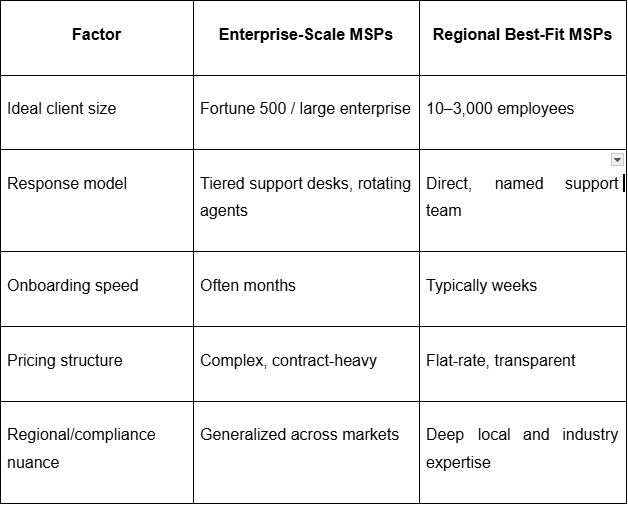
The best providers quote flat, predictable pricing per user or device. If a provider won't give you a straight answer on cost structure during a sales call, expect surprise billing later.
Skip the star rating and read for details: Did the technician actually resolve the issue on first contact? Was communication proactive or did the client have to chase updates? Do the reviews look legitimate?
A 3,000-employee enterprise MSP and a boutique regional provider both have their place, but bigger doesn’t always mean better.
The right MSP should be appropriately sized for your organization. For smaller and mid-sized businesses, working with an extremely large provider can sometimes mean navigating multiple layers of support, less familiarity with your environment, and a less personal relationship.
At the same time, an MSP that is too small may lack the depth, coverage, or specialized expertise your organization needs.
Look for a provider that has the resources and expertise to support your business while still making your organization a priority.
Not every business needs the same type of MSP. Use this breakdown to narrow your search:
.
What is the difference between a managed service provider and IT support?
IT support is typically reactive fixing problems after they occur. A managed service provider is proactive, using continuous monitoring, security tools, and strategic planning to prevent issues before they cause downtime.
Who are the largest MSPs in the world?
By revenue, the largest global MSPs include Accenture, IBM, Capgemini, CDW, NTT Data, and Cognizant, each serving large enterprise clients across multiple industries and countries.
How do I find the best MSP for my business size?
Match the provider's typical client size to your own enterprise-scale MSPs often serve Fortune 500 accounts, while regional MSPs typically specialize in businesses with 10 to 3,000 employees, offering more direct support relationships.
Are top-ranked MSP lists trustworthy?
Approach ranked lists with some caution; many are built on self-reported revenue data or paid directory placements rather than independently verified service quality. Use rankings as a starting point, then verify credentials, SLAs, and references directly.
What questions should I ask before hiring a managed service provider?
Ask about average response times, SOC/security capabilities, compliance experience in your industry, pricing structure, and whether they start engagements with a technical assessment.
The top managed service providers for 2026 aren't necessarily the ones with the biggest revenue numbers on a ranked list; they're the ones whose monitoring, security, compliance expertise, and response times actually match what your business needs. Before signing with any MSP, verify their SLAs, ask for industry-specific references, and confirm they lead with an assessment rather than a sales pitch.
Want to see what a best-fit managed service provider looks like for your business? Schedule a discovery call with Ferrara IT today.


© 2026 All Right Reserved | Ferrara IT