Outsourced IT gives small businesses access to enterprise-grade managed IT services, 24/7 remote IT support, and cybersecurity expertise without the cost of a full in-house department. For most small businesses, outsourcing IT lowers technology costs by 30–60% compared to hiring in-house staff, while also improving response times, security, and compliance.
If you're running a small business, IT probably isn't your job but it's become one of the biggest risks and costs on your plate anyway. A single unpatched server or a missed backup can cost more than a year of outsourced IT support. That's why more small businesses are moving away from the "hire one IT person and hope" model and toward outsourced IT services that scale with them. Here's what that actually means, what it costs, and how to decide if it's right for your company.
Outsourced IT means partnering with a third-party provider often called a managed IT services provider (MSP) to handle some or all of your technology needs: help desk support, network monitoring, cybersecurity, backups, cloud management, and IT strategy. Instead of hiring, training, and retaining an internal team, you pay a predictable monthly fee for a team of specialists.
There are a few common models:
Small businesses without any in-house IT typically start with fully outsourced IT services, while businesses with one overloaded IT generalist often have a co-managed model.
The clearest way to evaluate outsourced IT is to compare it directly against the true cost of hiring in-house. Most small business owners underestimate in-house IT costs because they only think about salary not the full stack of expenses behind one employee.
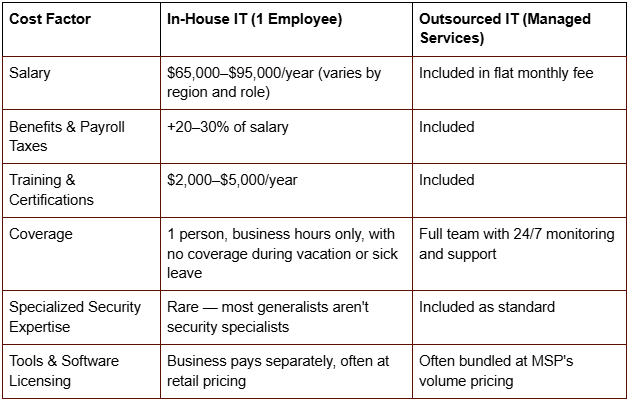
A single in-house IT hire, once you include benefits, tools, and training, frequently costs a small business well over $100,000 a year still has coverage gaps during nights, weekends, and holidays. Outsourced IT services typically cost a fraction of that for more skilled and more consistent coverage.
Managed IT services are typically billed as a flat monthly fee per user or per device. That predictability makes budgeting far easier than absorbing surprise repair bills, emergency contractor rates, or the cost of a data breach. Because MSPs support multiple clients, they also benefit from economies of scale better vendor pricing on hardware, software, and security tools than any single small business could negotiate alone.
Problems don't wait for business hours. Outsourced IT support gives small businesses access to a help desk and remote monitoring around the clock, so a server issue at 2 a.m. gets caught and often resolved before your team even arrives in the morning. That same proactive coverage typically extends to backup and disaster recovery planning, so a hardware failure or ransomware event doesn't turn into a multi-day outage. This is one of the most immediate, tangible benefits business owners notice after switching from in-house or break-fix IT.
Small businesses are frequent cyberattack targets because attackers assume they're under-protected. Outsourced IT providers bring dedicated cybersecurity monitoring, patch management, and for regulated industries like healthcare, legal, and financial services compliance expertise for frameworks like HIPAA, NIST, GDPR, and CMMC. That's a level of specialization few small businesses can build in-house.
One in-house IT generalist can't realistically be an expert in networking, cybersecurity, cloud infrastructure, and compliance simultaneously. An outsourced IT services provider gives you an entire team of specialists, the same breadth of expertise a large enterprise IT department has, without the enterprise headcount. That specialization is especially valuable for businesses with industry-specific needs, whether that's a lean nonprofit balancing a tight budget against donor-data security or a manufacturer managing OT/IT convergence and uptime-critical systems.
As your business grows, adds locations, or shifts to hybrid work, outsourced IT scales with you. You're not stuck hiring (or laying off) staff to match technology needs, you simply adjust your service agreement, whether that means a network upgrade, a cloud migration, or a broader round of IT projects and assessments as your business needs evolve.
Every hour a business owner or employee spends troubleshooting a printer or resetting passwords is an hour not spent serving customers or growing the business. OutsourcedIT support solutions removes that distraction and lets your team focus on what actually drives revenue.
Not all IT service providers are equal. When evaluating outsourced IT services for your small business, look for:
If your environment is outdated and still on premise servers, a cloud readiness assessment is often the easiest low-commitment way to get a clear path and cost estimate to move to the cloud.. For more on preparing your systems for a transition like this, learn more at our website project pages: Microsoft Entra ID Migration Services and Cloud Migration and Optimization.
For small businesses in Philadelphia, Pennsylvania, Ferrara IT provides fully outsourced and co-managed IT services built around predictable, flat-fee pricing and a security-first approach. Rather than treating IT as a series of emergencies, Ferrara IT combines 24/7 monitoring, help desk support, and compliance expertise across HIPAA, NIST, GDPR, and CMMC backed by measurable results in customer retention, first-call resolution, and system uptime that the team stands behind for every client relationship. The same model supports businesses throughout the Philadelphia region and Blue Bell, PA, and across every other market Ferrara IT serves nationwide. If your business is weighing outsourced IT for the first time, or outgrowing a single in-house hire, that local, accountable partnership is often the deciding factor.
In most cases, yes. A single in-house IT hire once salary, benefits, training, and tools are factored in often costs more than $100,000 a year for one person with limited coverage. Outsourced IT services typically deliver broader coverage and expertise for a lower, predictable monthly cost.
An outsourced IT provider, or managed IT services provider (MSP), typically handles help desk support, network and server monitoring, cybersecurity, backups, cloud management, vendor coordination, and IT strategy either fully managing your environment or supplementing existing in-house staff.
Yes. This is called co-managed IT, and it's common for small businesses with one IT generalist who needs backup for after-hours support, specialized cybersecurity work, or overflow during growth periods.
Reputable outsourced IT providers often have deeper compliance expertise than an average in-house hire, since they work across multiple regulated clients and stay current on frameworks like HIPAA, NIST, GDPR, and CMMC as a core part of their business.
Most providers start with a discovery call and a free consultation to assess your current environment, followed by a tailored proposal typically within a week outlining the transition plan, pricing, and service scope.
If technology issues are slowing your team down, or you're weighing the cost of hiring in-house against outsourcing, Ferrara IT can walk you through what a tailored IT strategy would look like for your business. Schedule a discovery call to get started, or browse the Ferrara IT blog for more insights on cybersecurity, compliance, and IT strategy.


© 2026 All Right Reserved | Ferrara IT